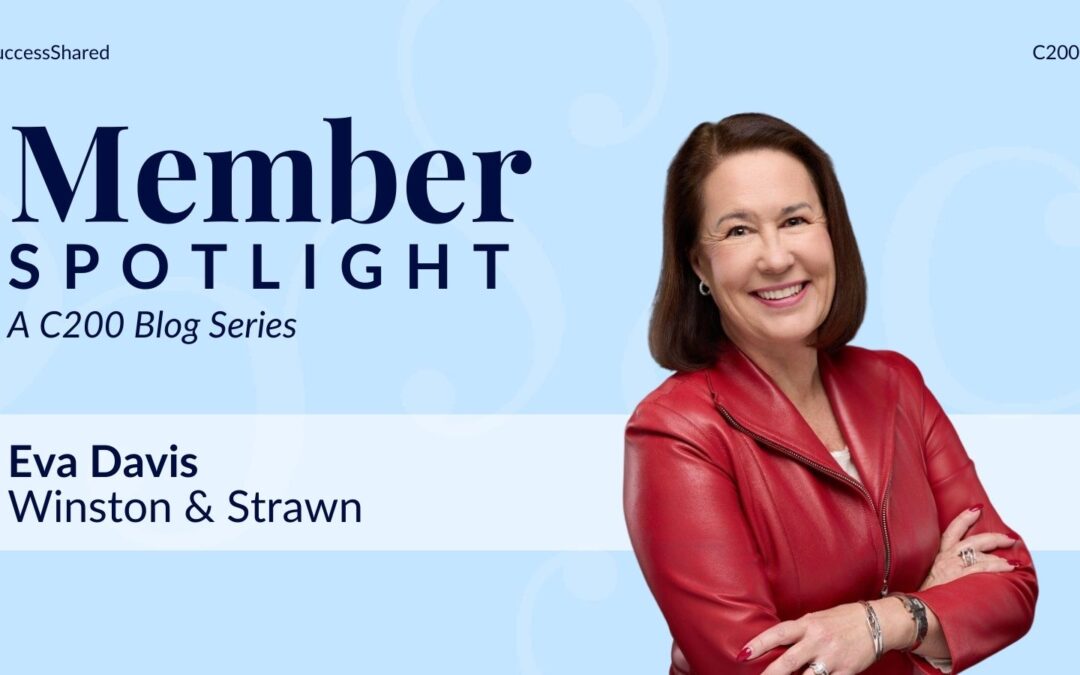
Eva Davis is Managing Partner at Winston & Strawn, a global law firm with over 1,500 business professionals across 14 offices and 5 countries. She leads external affairs, focusing on clients, business development, marketing, branding, sales, and firm growth—including lateral partner hiring and acquisitions. Eva is also a seasoned M&A lawyer, advising some of the country’s most active private equity funds and founder-backed businesses across a number of industries with a particular focus on consumer products, technology, and industrials. Her career is driven by curiosity, a “getting to yes” mindset, and a commitment to continuous learning. She resides in Park City, Utah and also spends time in Hermosa Beach, CA, enjoying skiing, hiking, kayaking, stand-up paddle boarding and, most recently, country western line dancing. Eva joined C200 in 2025.
Eva Glassman: Please tell us about your role at Winston & Strawn. What do you love the most about your work, and what are some more challenging aspects?
Eva Davis: As one of three Managing Partners, I help guide our Chairman in running a billion-plus-dollar firm with 1,000 lawyers and 500 business professionals across the US, Europe, and South America. My focus is on all things external: clients, business development, sales, client special projects, marketing, and branding—as well as initiatives that drive firm growth. Previously, I chaired our firm’s transactions department, overseeing half the firm’s P&L and talent. Today, I work to solve our clients’ most complex challenges in a rapidly changing world and regulatory landscape.
Alongside my leadership role, I remain an active M&A dealmaker, primarily serving middle-market private equity clients and private companies. Recent highlights include advising Ghost Beverages on its sale to Keurig Dr Pepper and guiding LesserEvil in its sale to Hershey; both deals valued at over $1.0 billion. I thrive on the dynamic nature of M&A, especially in consumer brands, but also for bespoke manufacturing, technology, and lately, AI. If you’d like to hear any of my M&A tips, please check out my podcast “What’s the Deal?” that I post every other week on LinkedIn.
EG: Did you always know that you wanted to go into law?
ED: I’m one of those people who knew I wanted to be a lawyer at age seven. I grew up in the Washington, DC area. My father was a lawyer who worked for the federal government, but not in a big high-profile position. I found lawyers and their work interesting because they were always solving problems.
My early career included a range of legal work, from serving as a gofer, then secretary, and finally paralegal at a three-attorney firm near my childhood home during high school and college. That experience allowed me to learn the ins and outs of running a business from client intake, service, billing, and collections to hiring and managing talent.
I was in law school when LA Law was popular on television, so that became my idea of what it was like to be a lawyer. How wrong was I?! Funnily enough, I ended up in Los Angeles for my career, and all my friends and family were asking, “So is your job like LA Law?” [Laughs] It’s definitely not.
After a decade of practice, in 1999, I joined Kirkland & Ellis, one of the largest, most profitable firms in the US, to start the firm’s private equity practice in Los Angeles. In that role, I helped build the firm’s West Coast transactions practice as a young partner and new mother—a challenging but rewarding leap.
Those first few years at Kirkland were really tough. If you had interviewed me two or three years into that experience and asked me, “Would you have made this law firm and professional change knowing how hard these past few years have been?” I honestly don’t know if I would have said yes. Fast-forward twenty years later, if you ask me the same question, I’d say “Absolutely yes.” Sometimes you wonder, “What the heck did I get myself into?” and you just have to stay the course. And I did, and it worked.
EG: What are some moments you look back on and consider an important pivot point in your career? What were the moves you made to get you to that next step?
ED: Key career pivots included changing firms (twice) and stretching into new areas of expertise, even when uncomfortable. My move to Winston & Strawn eleven years ago was driven by client needs and market fit, and at the time, I selected a firm where I was comfortable with the culture, respected the partners, and had confidence in our own collective ambition.
Running for Chairman two years ago was a significant step. There were six of us who ran—five men and me. I ran because I thought I could do a great job in the role, and I wanted the additional leadership responsibility. I was also aware of my visible role as one of the most senior women at the firm, and I felt responsible to my women colleagues to show that it was possible for a woman to run a global law firm. It was a nine-month process, and I ultimately lost—but I positioned myself well enough that my new Chairman asked me to be one of the three Managing Partners supporting him.
EG: I’m curious about your journey to C200. How did you discover the organization? What made you join?
ED: When I lost the Chairman race, I was obviously disappointed—I really went for it. Several months passed before I was eventually offered the Managing Partner role, and during that time, I was planning my next challenge: to sit on the board of directors of a public company. I joined a couple of other women’s organizations that were focused on placing board-ready women on public company boards. While these organizations have some sense of community, none of them were focused on senior women currently running businesses and responsible for P&L. My network needed new connections: amazing senior women leaders who are still active in their careers.
Joining C200 was a combination of seeking my next challenge or chapter, as well as expanding my network to get into spaces with some fantastic senior women leaders. I am also passionate about connecting people, teams, clients, private equity funds, and current and prospective board members in my network with each other to develop innovative solutions, solve problems, amplify voices, and help find the next business, professional, or personal opportunity. I plan to do just that as a Member of C200.
EG: You mentioned that you were the only woman running for the Chairman position. When you first started working at a law firm, what was your experience like finding other women to connect with or aspire to?
ED: I’m one generation right after the generation of “first women”—the first woman partner, the first woman to run a practice group, the first woman to run an office, the first woman to run a firm—so I did see senior women at law firms who were inspirational. However, there weren’t that many. Almost all of my mentors over the course of my career were in fact men—because there were just more of them. I had a collection of people at different levels giving me advice and tips, but never a traditional mentor or singularly instrumental person who was a woman.
I was very conscious of how few women were in the senior ranks at the three global law firms where I have practiced for 35 years. This ties back to a key reason for me running for Chairman—I know how important it was for me to see what was possible, even if it was seeing just one senior woman in a key position.
When it comes to “mentorship” or seeking advice from others, I’m very much someone who subscribes to the “Personal Board of Directors” approach. For me, many of the people on my Personal Board are not within my own organization. Sometimes, I just want to sit down and be really honest, have blunt conversations, and get real tips—which is not always possible within your own organization. These board members have given me great advice on next steps, how I should think about my career progression, what I’m seeing in the market, how I’m handling clients, approaching issues, and so on.
Now that I’m part of C200, I’m excited to get to know the other Members more and hopefully become part of a really great network of Personal Boards.
EG: What does being a “woman in business” mean to you? How does that impact the way you lead and work?
ED: I have always believed that we need more diverse perspectives, gender or otherwise, to come together and solve our clients’ biggest problems. Whether you were trained as an engineer, an English major, or a lawyer, your life experience informs your perspective, and that really matters. I want to promote diverse perspectives in my leadership and day-to-day actions.
While I hesitate to subscribe to stereotypes or over-generalizations, I do feel that emotional intelligence and authenticity are hallmarks of women’s leadership, and I aim to model vulnerability and openness—sharing both successes and struggles.
I also seek to bring out the best in others, especially when meeting in groups—knowing that there are some people who are not going to speak first or be the loudest but may generate our best ideas. That ranges from how I might run a meeting, to whom I might call on, to whom I might seek to form committees or make decisions.
Demonstrating alternative ways to lead is also important. For instance, as a leader, I’m not someone who takes up the room. I contribute and speak when I have something to say. You don’t need to monopolize the conversation in order to get your points across. The loudest voice in the room isn’t necessarily the one with the most authority on an issue.
I also try to be an authentic, vulnerable leader for others to see as an example for how to lead. The “perfect” woman leader was something I saw much more in the 90s that I don’t see as much now. I try to embody a level of authenticity with others, especially so that women don’t see me and think, “She looks like she’s got it all together!” Because I don’t have it all together! I’m very intentional about sharing my struggles with my colleagues and those I mentor. Showing up as an authentic leader with your struggles each and every day can be hard. My goal is to show others that you don’t have to be perfect to make things work. Initiatives I spearheaded like “Candid Conversations” at our firm create space for honest dialogue and visibility for our women.
EG: Giving women the opportunity to bring authenticity to the workspace is so important because we all have the chance to change what being a leader looks like, so that it’s more attainable for everyone.
ED: To that point, I try to show up this way for our men, too. I’m a big believer that if the men are talking about their kids, families, culture, and their issues, women will feel even more comfortable in doing so as well. The obligation to change the workplace culture shouldn’t just fall on the women.
I was actually one of the initial advocates at my firm for equal parental leave for our male and female attorneys. Our parental leave now provides our mothers and fathers with the same amount of time. I also encourage our men to take the full leave because I don’t want any firm partners assuming the men on their teams won’t (and that the women will) take that time, which could impact staffing and promotion decisions. For example, if a partner assumes someone recently married and of a certain age will have kids in the next few years, I want the partner to also assume a man will take just as much parental leave as a woman, so the staffing or promotion decision is truly based on merit, not the risk that a woman might not be here next year.
EG: What is your advice to younger women trying to advance their careers?
ED: Prepare yourself for your next position now. When you have that greater ambition, how are you developing the skills that you need for your next role? Every organization is political—so how do you make your ambition known in ways that service the organization? Having a Personal Board of Directors to consult about these questions is huge.
In law firms and with our clients, I often see women who are at a point in their careers where they’re becoming partners or vice presidents between ages thirty and thirty-five—which is also the time when they’re having children. When experiencing these professional and life milestones, it’s important to figure out ways to stay visible.
While it’s good to be selective and intentional with your time, if you’re seeking that next level, it’s the opportunities you accept that will help you reach it. Say yes to the things that matter and help advance your career, your development, and your learning—even if it’s difficult or uncomfortable. At the same time, give yourself permission to say no to things that aren’t going to matter, whether it’s personal or professional.
C200 is a 501(c)(3) nonprofit organization with a mission to inspire, educate, support, and advance current and future women entrepreneurs and corporate profit-center leaders. The views and opinions expressed in this article are those of the individuals quoted or featured and do not necessarily reflect the views, policies, or positions of C200.
