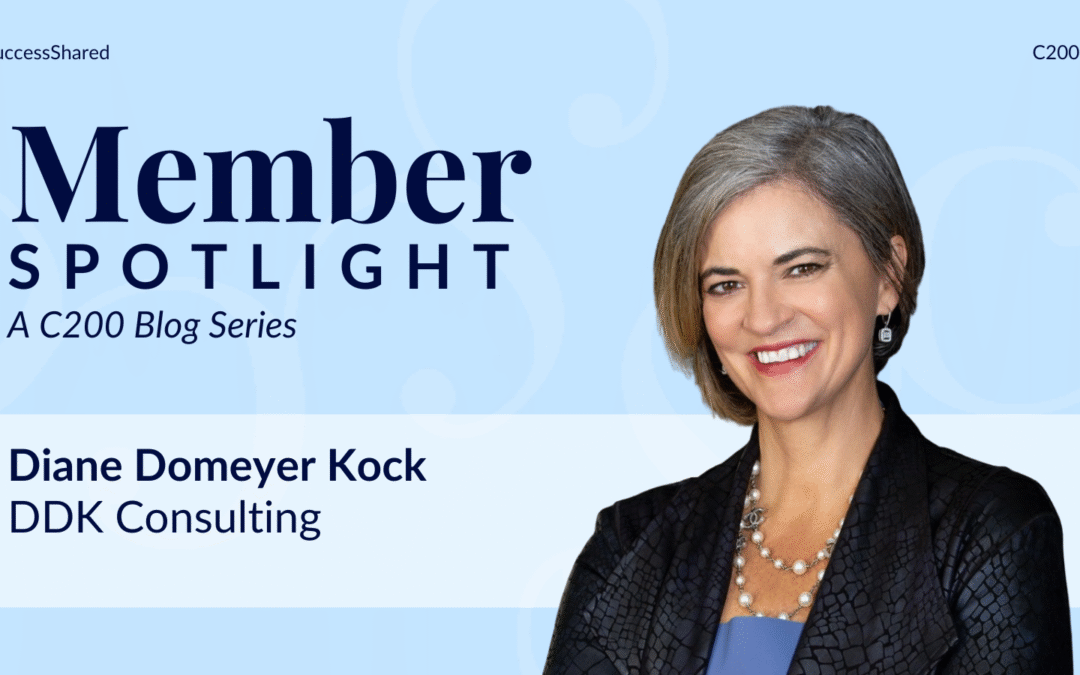
Diane Domeyer Kock is President and Founder of DDK Consulting, a firm supporting women-owned businesses and helping to close the wealth gap for women. Before “rewiring” to found DDK Consulting, Diane led a multi-decade career at Robert Half, a global staffing company, where she built her expertise in growth strategy, business transformation, the future of work and career journeys. Diane has made several career pivots during her tenure at Robert Half, all of which intentionally supported important chapters in her personal life, and consistently chases work that taps into her “zone of genius.” Outside of work, Diane enjoys spending time with her family and participating in cycling adventures around the world. Diane has been a member of C200 since 2026.
Eva Glassman: What is your current role?
Diane Domeyer Kock: Currently, I am the President and Founder of a very small consulting firm, DDK Consulting. Before that, my professional career included 25 years as an executive with Robert Half, a global staffing company, as a transformation expert and growth strategist for emerging business lines. There, I was able to build expertise in the areas of the future of work and career journeys, while learning to run very large businesses from an operations perspective.
After 32 years with the same company, I decided it was time for a “rewirement” and made the intentional decision to commit my time, talent, and treasure to helping close the wealth gap for women. I do this by building upon those 30 years of expertise at my former company, but also investing in women-owned businesses, seeking board roles with women-owned businesses, and consulting for growth strategy to help them grow and expand.
EG: What has the transition been like from a multi-decade career at a global company to starting your own firm? What past experiences have played an important part in developing this new chapter of your career?
DDK: Career journeys are interesting. When you are young and set out on your professional career journey, there’s an expectation that careers are linear. But what I have learned and continue to learn is that career journeys can be very unpredictable. When you look back at the decisions to make a new career shift or pivot, it changes your life, but your life also informs what your journey will be.
While I was fortunate to be with one company for a very long time, I held many different careers opportunities there, and I can look at almost each of those career pivots and tie them to things going on in my life. For example, I was fortunate that my husband was a stay-at-home dad—at a time when that was very uncommon. That gave me the freedom to have a very aggressive global travel schedule. When my third child was born, even though my husband could do ponytails with the best of them, I wanted to be home for my three girls. So, I wrote the job description for a new role at the company that got me off the road. I did that role until the youngest was in kindergarten. When I was able to pivot and do something that required more travel again.
As my girls grew older and headed into their own maturity, I wanted to be home again; as a mom, you want to be there when your daughter has her first period and not in a hotel thousands of miles away. I again pivoted to a new job with much less travel but learning a new skill. I was fortunate to be with a company that allowed for career sequencing, ensuring the job fit with the demands of my personal life.
The last big pivot was my decision to leave and start my consulting firm. As a woman over 50, I had a lot of life challenges come together when I was at the peak of my career: aging parents, caretaking for my spouse who was having surgery, launching adult children. I suddenly lost a best friend of 40 years. I was going through menopause. Suddenly, it just wasn’t working for me anymore—so I decided to pivot.
I was very intentional about my last move to leave the company. Over the course of about 18 months, I carefully contemplated whether it was time to leave and how to do so gracefully. Instead of just retiring from my role, I made a recommendation for the company to restructure for efficiency and to eliminate my job, giving me the freedom to help in the transition and move on.
Now, I am in a chapter of my career that has a lot more freedom. I choose what I do, what I don’t do, whether it’s true to my mission, whether it’s true to my zone of genius. I’m less beholden to an organization at a time when life transitions are pretty significant.
Looking back at my career, my philosophy is that that careers are journeys that weave in and out of life dynamics. Also, your definition of what success is changes overtime, especially in later chapters.
EG: Tell me about your journey to C200. What drew you to the organization, and what are you most excited about as a new member?
DDK: There’s tremendous power in women coming together who have diverse but shared experiences. I had previously been very involved in a lot of industry organizations but had long searched for a true peer-based executive organization. A lot of them are very focused on women executives acting as mentors—which I think has tremendous value—but being a woman executive of the top can be very lonely. It’s very transformational, in my opinion, to be with a peer group of women where you can be authentic and continue to grow together.
I used to belong to another executive women’s group, which was a transformational experience. However, I want to build upon that by being with executive women at a higher level, who are truly at the top of their game. I’m looking for community, connections, personal growth, and content that can help you be the best you can be—not just professionally, but holistically. And that’s why I joined C200.
EG: Throughout your career, what has your experience been like finding other professional women to connect with?
DDK: I was very fortunate to be with an organization that really supported women at every phase of their journey and where women were very well represented amongst the executive ranks. I will say, however, when I was a young executive there, it tended to be more male dominated. But that changed over time. And while the organization really supported those career pivots for me, they were based on the needs of my family. That was a great example of how they have supported women.
But there was still a lot of need to build upon that support. It wasn’t until 2020 that we created a global executive women’s network, of which I was the executive sponsor. It took almost 25 years until we formalized our employee resource group for women—and it quickly became our most successful employee resource group.
It’s really important to continue to advocate for support, because it’s a challenge for women to navigate our careers, integrating everything. In the late 1990s, I was fortunate to be recognized as one of the most influential women in the San Francisco Bay Area. I was a young woman executive at the time, and the way I reacted to the recognition showed my naivety. I was a bit like, “I’m not big on gender. Why do we have an award like this for women, when we’d be up in arms if they had the same award for men?” What I understand now is that there are unique challenges for women, and it’s significant to recognize those who have overcome those challenges and achieved great success, so we can share those learnings with each other.
EG: What does being a “woman in business” mean to you? How does that impact the way you work and lead?
DDK: I think we have a responsibility—not only to hold ourselves to a standard of success, but to lead authentically and bring our natural inclinations to drive success and support all levels of diversity. It’s important that we resist trying to fit the way we lead into an existing mold. If we lead authentically, it’s proven that we will have not only better business results, but also pave the way for all diverse groups to be heard, recognized, and successful in the workplace.
In my opinion, there are four pillars women need in order to feel authentically successful and fulfilled. The first is professional growth; you need to always build upon your expertise. The second is health and wellness, which can be very challenging to balance professionally. The third is community and caregiving, which women in particular bear more of a burden. The fourth is financial wellbeing—which is more than “financial security” early on in your career, but later, it might look like building wealth or passing it onto your children. Tending to each pillar is important for long-term fulfillment.
EG: Outside of work, what do you like to do for fun? How do you like to spend your free time?
DDK: Aside from spending time with my five children and now grandchildren, I love blending my love of travel with my passion for cycling. In addition to participating in RAGBRAI, a 500-mile ride that brings us back to our Midwest roots, we have completed cycling adventures in Ireland, France, Germany, and Switzerland. This year, we will be doing so in Tuscany.
EG: What is your advice to aspiring women business leaders to advance their careers?
DDK: Pay attention to that which gives you energy. I mentioned the “zone of genius” earlier. When you are in your zone of genius, it gives you energy. It furthers your success, it gives you fulfillment. It’s like you’re in the zone, or your flow state. Pay attention to what that is, especially as you navigate different career decisions. Are you considering a role simply for more money or a new title, or is it truly going to help you tap into your zone of genius? If something taps into my zone of genius, I’m guaranteed success. I’m guaranteed fulfillment. It takes a little while to figure out what that is. You probably know which things you have done in your career already that drain your energy, but then there are the things that really get you in the zone—that’s your zone of genius. Paying attention to how you can incorporate that into your day-to-day roles to ultimately find satisfaction and fulfillment.
People always say, “Do what makes you happy,” but I think it’s more than that. We all have intrinsic gifts, some that we’re not even aware of, but if you listen to your physiological response to the work that you do, you’ll know the things that you’re ultimately destined for.
C200 is a 501(c)(3) nonprofit organization with a mission to inspire, educate, support, and advance current and future women entrepreneurs and corporate profit-center leaders. The views and opinions expressed in this article are those of the individuals quoted or featured and do not necessarily reflect the views, policies, or positions of C200.
