by Eva Glassman | Jun 11, 2026 | Blog, Featured
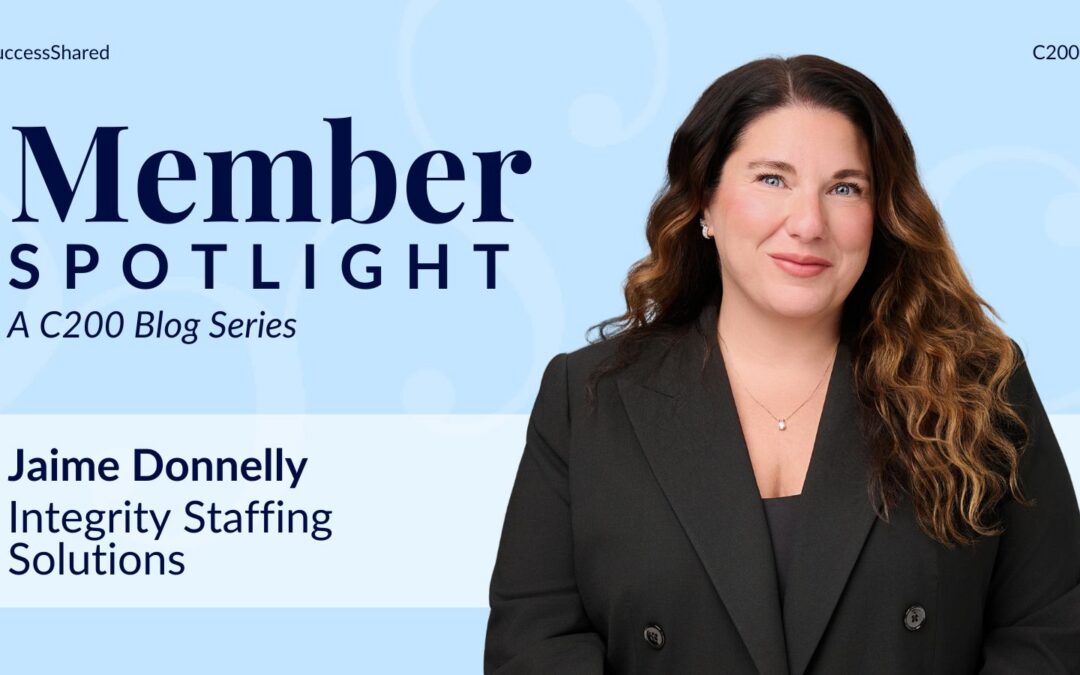
Jaime Donnelly is CEO of Integrity Staffing Solutions, one of the largest privately held staffing companies in the United States. Jaime has worked for Integrity for twenty-five years, starting her career as an on-site recruiter. Jaime credits her advancement through the company to her constant mindset of staying fearless and curious in the face of new opportunities, as well as her personal and professional support systems, both of which proved pivotal when her career gained momentum while she raised three young daughters. Outside of work, Jaime savors her time spent with her daughters, all of whom are now in their early twenties and nearly finished with college. Jaime has been a Member of C200 since 2026.
Eva Glassman: What does Integrity Staffing Solutions do, and what is your day-to-day like as CEO? What do you love about your role, and what are some more challenging aspects?
Jaime Donnelly: I have been with Integrity for over twenty-five years. Nobody ever says they want to be in temporary staffing when they’re little; there’s no degree path for this. I actually went to school to sing opera, but realized I needed a different career path if I wanted to make a good living.
I took a little bit of time off from school, and I landed a job recruiting for Amazon in its infant stages, which was really wonderful. In that experience, I got to work directly with multiple staffing partners, one of which was a temporary staffing agency called Integrity Staffing. We went from fifteen temporary staffing partners down to one: Integrity. In that time, working on the client side with Integrity, I got to know the owners very well.
Eventually, it was time for me to make a career move, and I was also moving back home to the East Coast. I called Todd, who is one of the owners of Integrity, and I asked, “Do you have any clients you can place me with?” And he said, “Come work for me.” That was twenty-five years ago, and I have been here ever since.
I started in my role at Integrity as an on-site recruiter, managing the one-hundred temporary consultants we had working at JPMorgan Chase. I would do payroll, events, act as counsel and coach, and manage attendance issues. Over time, Sean, the other owner of Integrity, would ask me to take on more tasks, allowing me to dip my toes into different areas of the business. That really changed the trajectory of my career here. Over the course of twenty-five years, getting asked “Hey, can you do this? Can you help with this?” over and over again has led me to where I am today: the CEO of one of the largest privately-held staffing companies in the US. I get to lead this amazing team of people who really make a difference in people’s lives every single day.
EG: Not everyone gets the experience of growing throughout the entire company. What was that experience like, advancing your own career in one place? Looking back, what were some moments or moves that proved pivotal to your advancement?
JD: I tried to have a sense of fearlessness and remind myself that if someone is asking me to do this, they must think I’m capable of doing it right. I pushed aside the self-doubts; I went to school to sing, not to be in finance! However, Todd and Sean believed in me, so I had to push aside my fears, jump in, and get curious. That mindset served me well along the way, and it’s something I would encourage every new, young leader to lean into.
I also got comfortable with figuring things out along the way and failing fast. If I failed at something, I was the first to recognize it, pivot, and share what went wrong and why. At Integrity, I was given the grace and freedom to fully own not only my failures, but also how I would move forward from them. This is something I continue to champion within my teams. We don’t need to browbeat people when they fail; it’s a learning opportunity.
I’m so thankful to the founders of Integrity for all the grace they gave me over the years, because I succeeded more times than I failed. But it was the lessons in those failures that created growth for me as a leader and an individual.
Coming from the performance industry, I developed a thick skin to “no” from a very young age. Very often, I didn’t get that role, I didn’t score highest at the competition, I didn’t win that trophy. When I came into the business world, I learned that things don’t work out all the time, but the more important questions are: where do we go from here? What will we try next?
When you fail, being transparent in your failures is key. Integrity created an environment where I could fully admit, “I didn’t do so great on this one,” or “I made a mistake.” And the response always was, “Thank you for telling me that.” Transparency is important because if someone gets blindsided by something, that’s when things actually don’t go well. That’s when failure isn’t received well.
EG: Many of our Members may recognize you from our 2025 Annual Conference, where you were a featured speaker. How was that experience part of your journey to becoming a Member of C200?
JD: The 2025 Annual Conference was so fun—but I was so nervous getting up on that stage! It was nerve-wracking being in front of a room of so many amazing women leaders. I questioned, “Why does anyone want to hear from me?” But the C200 women are such a welcoming, amazing group. I got so much from that experience.
I was actually in the process of joining C200 before my session at the 2025 Annual Conference. I was initially hesitant to join because I was worried about the time commitment, so when I was asked to speak at the conference, I thought it would be a great opportunity to get a “taste” of the organization and the other Members.
Again, I was really scared. It’s intimidating walking into a room of several hundred, incredibly successful, confident women. Was I going to be accepted? Many of these women have been together for decades. Would I be an outsider looking in? Would I have a seat at the table?
As soon as I walked into the opening session, it was like a warm blanket was wrapped around me—as if I was already a Member. My nerves immediately dissolved; I was welcomed right away. Literally and metaphorically, people pulled up a chair and made room for me, seeking me out to ask me questions and hear my perspective. In turn, I was able to hear from everyone else in the room, learn, and digest this amazing experience from all these women. After the conference, I was like, “Well, this is a no-brainer.” It was clear as day how much I would get out of being a C200 Member—so clear that I knew I would naturally prioritize this group.
C200 represents a place for women to not just get together and celebrate their successes, but to share their learned experiences, and to challenge each other’s ways of thinking in natural, supportive, and encouraging ways. I can’t imagine a better place to invest my time, both personally and professionally, because it’s so uplifting and developmental.
EG: What was the representation of women like at Integrity throughout your career? What has your experience been like finding other professional women—both in and out of your organization—to connect with?
JD: I have been so blessed and fortunate in my career. I’ve only really worked for two organizations: Amazon and Integrity. At Amazon, it was very natural to be surrounded by women. That was never an issue, even in a distribution warehouse environment.
At Integrity, I have the privilege of working for two men who are partners in business and in life—they’re married. They have created a culture of acceptance and support regardless of your gender, identity, race, religion, or whatever it may be. It does not matter at Integrity. I grew up in this diverse melting pot of an organization where I never questioned whether I could advance as a woman. Sixty percent of our leadership team is women; it was simply never a question. I was always championed.
It never occurred to me how lucky I’ve been until I started working outside Integrity on different boards and affiliation groups, where I saw just how few women leaders there were in my industry. I realized I couldn’t take it for granted just because it happens organically and naturally in my organization.
EG: To that point, what does being a “woman in business” mean to you? How do you apply that thinking to your work and leadership?
JD: It means creating an environment where equity and support are so natural that the next generation of women leaders aren’t thinking about it the way that other women in my generation had to.
As my career was taking off, I had my three daughters—one at twenty-five and twins at twenty-seven. I’m forty-eight today. In so many ways, I was stepping into much bigger boots than I ever had before. When my girls were little and needed care, instead of my husband at that time saying, “Okay, you should step back,” he said, “Okay, I’ll stay home.” This was at a time when stay-at-home dads were incredibly uncommon and hardly talked about. He stayed home and supported my girls and me, letting me achieve my dreams.
I’m not sure if I would have been as receptive to this plan if I didn’t already have an amazing foundation of support—not just at work, not just at home, but from a young age in general. I was raised with the idea that I could do whatever I put my mind to. I’m so lucky that my girls got to see that in action: a dad who stayed home and a mom who went out and conquered the world. To this day, they are in awe of having a mom who’s a leader. None of them are going into business, though! [Laughs] They all picked different career paths.
EG: When you aren’t at work, how do you spend your time?
JD: Most of my free time is spent with my girls—every chance that I get. I know my time with them is dwindling because they’re moving into adulthood. My oldest is twenty-three, and my twins are twenty-one. Having three of them so close in age is such a blessing. I’ve got two graduates—one who just graduated from college a semester early in January, and another who graduates next spring. Everyone is almost finished and out of the house, so it’s about spending every single moment I can with them these days: vacations, Sunday dinners, birdwatching (yes, one of my daughters loves birdwatching). In the future, there will be plenty of time for me and my hobbies, so right now, it’s all about my girls.
EG: What is your advice to aspiring women business leaders to advance their careers?
JD: I’ll never forget this moment when I was fourteen or fifteen years old, at a singing competition. I was waiting in the hallway outside the auditorium to perform for the judges. My father was waiting with me, standing across from me against the other wall. He said, “You look pretty relaxed. You’ve got this.”
“I’ve got this in the bag, Dad,” I said. “There’s no one who is going to beat me. I’m not worried about it.”
My father came across that hallway and closed the gap between us so fast. He stood right in front of me, right up in my face, looking at me, and said, “Do not ever forget that you can always be replaced.”
I wasn’t nervous before, but now I certainly was. It was a humbling moment for me. That one lesson from my father—I can still feel that moment, clear as day, thirty-four years later. It’s a lesson I took with me throughout my entire life. You can always be replaced—so don’t let your talent, skill, or praise from others make you complacent. That lesson helped me get to where I am today.
Now, as a leader, I have learned that I need to hire people who can replace me. I always need to work with people who are smarter than me, because I want to be replaced eventually—I want to take that next role. For that to happen, I need to have a team that is ready to replace me.
Finally, something else I learned is that I don’t have to be a virtuoso in everything. As you advance in your career, you eventually become the conductor. The conductor is not a virtuoso on every single instrument; they just need to know how to get them all to work together. As a great leader, you have to inspire followership and get people who want to be on your team. That means giving people room to shine—just like Todd and Sean did for me all those years ago.
Today, my job is to create an environment where people have a path to grow, can be constantly challenged, have the space to fail, and where someone can replace me when the time comes. I want that trajectory for someone else in the organization. Creating a path for others feels better than creating a path for myself. It’s important to me that I nurture the environment that nurtured me.
C200 is a 501(c)(3) nonprofit organization with a mission to inspire, educate, support, and advance current and future women entrepreneurs and corporate profit-center leaders. The views and opinions expressed in this article are those of the individuals quoted or featured and do not necessarily reflect the views, policies, or positions of C200.

by Eva Glassman | May 21, 2026 | Blog, Featured
Andrea Picard is a Managing Director at Golub Capital, a market-leading direct lender and specialized private credit manager, where she leads the Global Investor Solutions team. With an undergraduate background in linguistics, Andrea’s career in credit and finance began with serendipitous random conversations that led to her first permanent position at Lehman Brothers in their taxable fixed income group. Today, Andrea leads a team across multiple continents and deeply values her time developing talent within her organization, especially the rising women leaders. Andrea has been a C200 Member since 2026.
Eva Glassman: What is your day-to-day like as Managing Director of Golub Capital? What do you love about your role, and what are the more challenging parts of the job that you navigate?
Andrea Picard: I lead our Global Investor Solutions team, which oversees our global distribution effort. Most days, I’m either partnering with our sales team to shape and execute regional strategies or meeting with current and prospective clients. I’ve always loved leading sales teams and working closely with clients. There’s a real sense of satisfaction in understanding a client’s challenges and helping develop solutions that meet their needs. And of course, it’s especially rewarding when our teams are exceeding their targets. One of the more challenging aspects of the role is navigating volatile and unpredictable markets, which can quickly shift client preferences and priorities.
EG: Was your career goal always to be a leader in finance?
AP: I wish I could say it was all part of a grand master plan, but it wasn’t—not at all. When I graduated from college, even though I was a strong math student, I had a degree in linguistics, which didn’t point to an obvious commercial career path.
A fun fact is that my early career really came together through chance conversations. I got my first job offer—a temp role—while chatting with someone on the Long Island Railroad, and later landed a permanent role after sitting next to a senior person from Lehman Brothers on a cross-country flight. At the end of the trip, he told me I’d make a great bond salesperson. I wasn’t even sure what that meant, but I kept his card. About a year later, I called him, which led to a position on Lehman’s taxable fixed income team. I started in mortgages, quickly moved into high yield, and that ultimately launched my career in credit and finance.
EG: As you advanced in your career and took on more leadership roles, when you look back on those experiences, are there any pivotal moments that come to mind that were important to your success?
AP: At different points in my career, I’ve looked back and wondered whether I should have asked for more or been more assertive. That said, there isn’t much I would change. There were, however, a few pivotal moments that shaped my path.
One that stands out is my time at TD, where I was on the high yield sales team. When the head of sales was preparing to retire, I hoped I would be considered for the role. When the process seemed to be moving slowly, I decided to ask for it directly. It was something I had never done before, but it turned out to be a pivotal move—I got the job.
That experience reinforced an important lesson: you have to ask for what you want. You can’t always keep your head down and assume your work will speak for itself. I think a lot of women are conditioned to operate that way, and frankly, I can still fall into that trap myself. Over time, though, I’ve become much better at recognizing when I need to raise my hand and advocate for myself. No one can read your mind.
Joining BlackRock was another major pivot for me. I had never worked at an asset manager before and wasn’t entirely sure what my path there would look like, but I had always liked working at large firms. I felt confident that if I could get into an organization like that, I would find my footing.
I ended up accepting a role for which I was under-titled, overqualified, and taking a significant pay cut. Fortunately, I was able to move through the organization quickly and was put up for Managing Director the following year. In hindsight, I’m grateful I had the confidence to put myself in that position, even when the short-term tradeoffs were significant.
EG: How did you discover C200? What drew you to the organization and made you join? As a new Member, what are you most looking forward to getting involved with?
AP: I found my way to C200 through Marilyn Skony Stamm, a longtime Member, after we connected at a dinner. Marilyn became a trusted mentor and friend, and over the course of several conversations, she introduced me to C200 because she felt it aligned with many of my interests and values. I was thrilled to be nominated and am excited to now be an official Member. What I’m most looking forward to is continuing to build relationships with accomplished senior women leaders who are thoughtful, generous with their advice, and deeply supportive of one another.
EG: Throughout your career, what was your experience like connecting with other professional women, particularly as mentors? Did you see senior women leaders when you were rising the ranks?
AP: I’ve had many mentors along the way, both men and women. Earlier in my career, most of them were men simply because there were not many senior women in finance at the time. Over the years, that shifted, and more of my mentors became women. That change was a direct reflection of more women rising into leadership roles—and, importantly, bringing other women up with them.
EG: What does being a “woman in business” mean to you, and how does that impact your work and leadership?
AP: It means something very different to me today than it did earlier in my career. When I was younger in finance, my focus as a woman in business was on advancing my own career. Today, it means developing talent—both men and women—but especially helping more women rise.
There’s a real responsibility that comes with being a woman business leader: to support other women as they grow and advance. You have the opportunity to be the sponsor and advocate you may have needed yourself when you were coming up.
EG: Outside of work, how do you like to spend your free time?
AP: I enjoy cooking, traveling, reading, and just about anything outdoors. I love the mountains for hiking and skiing, and I also enjoy long walks on the beach. I have two children—a 32-year-old daughter and a 31-year-old son.
EG: What is your advice to aspiring women business leaders to advance their careers?
AP: Most importantly, have goals and articulate them. People can’t read your mind. At the same time, to borrow a golf metaphor, don’t grip the club too tightly. Organizations are constantly evolving—leaders change, managers come and go—and it’s important to take those shifts in stride.
Also, be thoughtful about job changes. The grass can always look greener, so it’s important to make sure you’re leaving for a better long-term opportunity rather than simply chasing short-term gains.
And finally, don’t forget to live your life in the meantime. It can’t be all about work.
C200 is a 501(c)(3) nonprofit organization with a mission to inspire, educate, support, and advance current and future women entrepreneurs and corporate profit-center leaders. The views and opinions expressed in this article are those of the individuals quoted or featured and do not necessarily reflect the views, policies, or positions of C200.