by Eva Glassman | Mar 19, 2026 | Blog, Featured
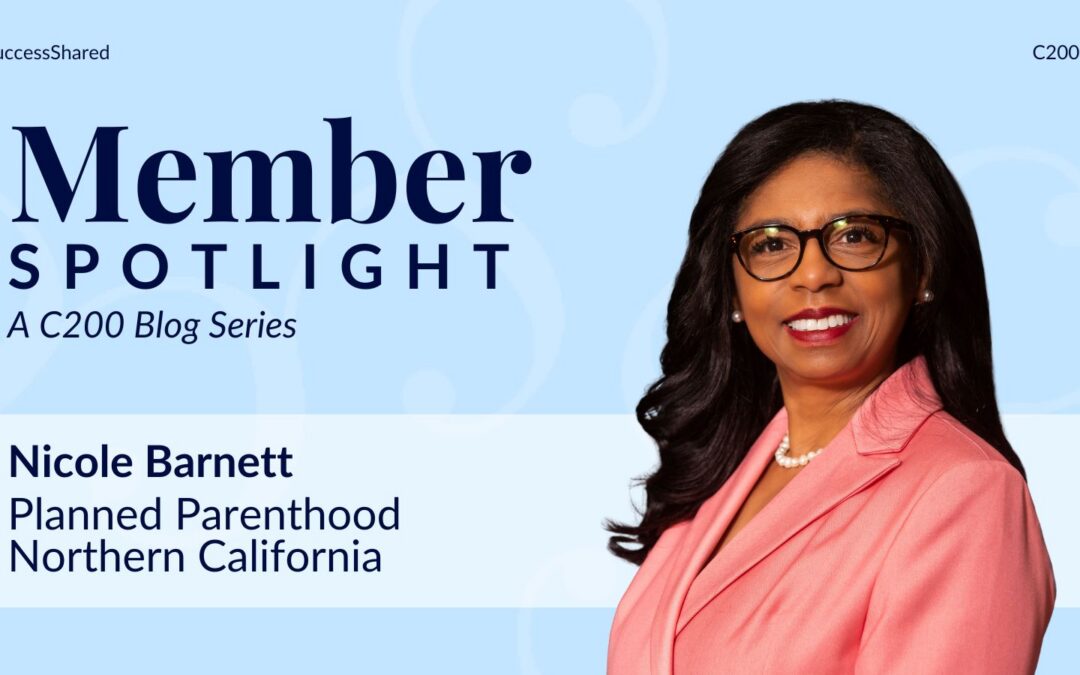
Nicole Barnett is President and CEO of Planned Parenthood Northern California, providing comprehensive sexual reproductive healthcare services at 17 centers across 20 counties. With an extensive background in corporate healthcare, including 28 years at Kaiser Permanente, Nicole describes her current role in nonprofit leadership as her most challenging one yet. Even still, her drive to deliver health equity to Northern California stems from her passion for serving others and supporting people in optimizing their health. Outside of work, Nicole enjoys spending time with her husband and two children and recently celebrated the birth of her grandson. Nicole has been a Member of C200 since 2026.
Eva Glassman: Tell me about your role as President and CEO of Planned Parenthood Northern California. What do you love about your job, and what are the more challenging aspects?
Nicole Barnett: I was named the President and CEO for Planned Parenthood Northern California on July 1st of 2025. Before that, I was the Chief Operating Officer for about a year and a half. I got to know the organization well from a boots-on-the-ground perspective, understanding the care that we deliver at all 17 health centers across 20 counties in Northern California. We also have a robust telehealth service, which is important for individuals who can’t travel or have other barriers to receiving care in person.
At this job, I’m most proud and excited that I get to stand at the intersection of health equity, social justice, and reproductive justice. This is an exciting time to be involved in those areas because of all the social shifts and polarization that we are seeing around different belief systems and ideologies. The question of what it means to be free and exercise your own bodily autonomy is at the center of this moment.
After spending almost 30 years in healthcare before coming to this role, this is the culmination of what I’ve always believed in, what my sense of purpose is, and the way I want to serve in healthcare and life.
After 28 years at Kaiser Permanente, from bedside nurse all the way up to the C-Suite, this role is a perfect fit for me, although it’s also the hardest job I’ve ever had. While all my jobs had their challenges along the way, this one is so difficult because of the resistance to what we’re trying to preserve, protect, and achieve. Our executive offices are in the same building as one of our larger health centers; every day, just like our patients, I also have to walk through the gauntlet of protesters who are screaming, yelling, displaying placards with hateful and shaming language—all kinds of things to intimidate individuals coming in and out of the building. People even yell at me to get a job somewhere else. I’m so appreciative of my 400+-person staff, all of whom wake up every day knowing what they have to face and still stand in the gap for others to protect their access to care.
Another challenging aspect of the job is navigating and clarifying the misunderstandings and misrepresentations about Planned Parenthood in general. Abortion is one of the many healthcare services that we provide, and is actually not the largest of our services lines. We provide cancer screening and follow up care, perimenopause and menopause consultation and care, behavioral health visits, connections to other community care providers, and we are proud to be a trusted provider of LGBTQ+ care as well. We even do vasectomies, a fact that always surprises people when I share it!
Despite all the challenges, I couldn’t be prouder to be here. We know that we have to stay engaged because if we don’t do this work, who will? We have allies across the healthcare industry, in our communities amongst our local, state and federal representatives. So we continue to fight and advance health equity because that’s what our patients deserve.
EG: With your extensive background in healthcare, how has your career journey prepared you for your current role? What takeaways from your earlier experience have helped you navigate the challenges of this role?
NB: At the end of the day, I remind myself that this is healthcare. This is about the relationship between the patient, the provider, and the surrounding team, who also give support. I started my career at the bedside as a registered nurse, so I understand that relationship well. I went into nursing because I wanted to be close to patient care and to support people in optimizing their health.
When I started my healthcare journey, I worked in inpatient nursing in hospital settings, which prepared me well when I moved to outpatient settings and clinics, as well as call centers as an advice nurse. I also worked in research and HIV testing and counseling, and served for many years as a Sexual Assault Response Nurse (thanks to training I received at Planned Parenthood Fairfield, CA). I had so many patient-facing experiences that fueled my empathy and commitment to a strong, culturally relevant, respectful, and trusting relationship between the patient and clinician.
Health is impacted by social determinants—not just the relationship with your doctor, but also whether you have safe housing, literacy, education, and transportation access. When I moved into leadership roles, this understanding helped me evaluate how to recognize and remove systemic barriers to optimize the experience from a patient perspective.
In my leadership roles, I did a lot of work in community outreach, healthcare disparities and reduction; health equity work; and strengthening partnerships with community groups that built and strengthened the safety net folks need to get the healthcare they require.
During the pandemic, I did a lot of teaching through local nursing programs. During that time, a lot of students couldn’t access traditional training settings in the hospitals; there was a huge need for instructors to help students graduate on time, so they could safely move into the system and become part of the workforce that was fighting the pandemic. I spent a lot of nights and weekends during the pandemic teaching because that was important to me and gave me a tangible way to contribute during the deadliest global health crisis of our lifetime.
All those experiences have helped to contribute to who I am today and how I serve in my role at Planned Parenthood.
EG: In terms of your own career advancement, what were some of the biggest factors that led to your success and ability to advance into leadership roles?
NB: I’ve always had a curiosity and openness to learning. At some points in my career, I could have been satisfied with where I was because it was safe, familiar, and paid the bills. But when you have that sense of curiosity, and you’re open to learning, you get beyond the fear of the unknown, and all kinds of possibilities open up. It led me to accept roles, experiences, and even interim opportunities that helped me build a stronger career foundation.
This mentality also introduced me to potential mentors, whether they were in a peer or formal capacity. When I took their advice, I began to grow into different roles and meet potential sponsors. Over time, my mentors and sponsors pulled me into opportunities I had never considered—until I was there and could see what was possible. The people around you often will see more in you than you see for yourself.
I’m not the kind of person who knew 20 years ago that I would be a CEO; that was probably the farthest thing from my mind! All I knew was that I enjoyed learning, growing, and doing meaningful work.
EG: Tell me more about your journey to C200. How did you discover the organization? What made you join? What are you most looking forward to as a new Member?
NB: Sometimes the best connections come through trusted friends and advisors and that is how I learned about C200. When I was preparing for my transition to the COO role at Planned Parenthood, I reached out to a colleague that had made a similar transition from a large healthcare organization to a non-profit. She is also a registered nurse, so I thought she was the perfect person to talk to. I reached out to her on LinkedIn, and she wrote right back to me. Just like that, we got on the phone and reconnected.
Over the course of several phone calls, I learned so much about her career experience, and she eventually said, “Oh, I want you to think about joining this organization—it’s called C200.” I looked at the website and heard her excitement and thought, “Wow, this would be a wonderful group for me to be a part of.”
I’m excited to be here because this is going to inform the next stage of my own growth and development. No matter how far you get, you’re never done learning and growing. There’s no top of the mountain, right? With the very hard role that I have as a CEO in reproductive justice, I’m hoping C200 will be a welcoming, safe space where I can find other women leaders whom I can open up to and receive encouragement and direction from as I continue to navigate the toughest job I’ve ever had.
EG: You’ve already spoken about how important your mentors and sponsors have been in your career journey. What has your experience been like, specifically finding other professional women throughout your career to connect with and aspire to?
NB: I worked for Kaiser for many years, which has a wealth of business resource groups for all kinds of demographics. I attended many summits for one of their resource groups, Women in Leadership, where I connected with so many people.
Fortunately for me, I had several women leaders who were in my circle of influence within my job who helped me advance within Kaiser. It was through them that I was invited to a group called Women Healthcare Executives of the San Francisco East Bay. I became incredibly active within that group, joining committees and the Board of Directors, which connected me with many more women who were in clinical and non-clinical roles such as doctors, nurses, and healthcare leaders. Last year, April 2025, I had the honor of being named their Woman of the Year, something I never would have thought I would earn.
EG: What does being a woman in leadership mean to you? How does it impact the way you work and lead?
NB: It is a powerful representation of what’s possible. When I was early in my career, people talked a lot about breaking the glass ceiling. For me, I’ve always worked as if there’s no glass ceiling. That’s what being a powerful woman in leadership is about. Don’t worry about the glass ceiling. Just continue. We find new ways to move forward each and every day. I found my way by looking for opportunities to serve, to learn, and to grow. Advancement comes organically when you focus on preparation.
I’ve been so thankful for the opportunities that have come my way, even when the road wasn’t as smooth as it appeared for other people. I didn’t accept that things are just the way they are, I found ways to stay encouraged through service. That’s what women bring to any situation. We find a way around it; it’s not going to stop us because we have our eyes on a larger goal. That’s the powerful thing about being a woman in leadership; no matter what the barrier is, we can imagine a way around it. We can imagine a world without barriers where everyone has an opportunity to shine.
Another thing that we do uniquely is that we lift as we climb. We’re the kind of leaders who don’t want to go alone. We might be the first ones somewhere, but we’re going to look around and figure out how to bring other people with us who don’t necessarily represent the traditional leadership or boardroom makeup. We’re going to bring those other voices with us.
EG: Outside of work, what do you like to do for fun? How do you like to spend your time?
NB: I love spending time with my family. My husband and I have been married for 37 years, and we have two children. Our son, Daniel, just got married last year, and I had the honor of marrying them at the San Francisco City Hall. It was so wonderful—they in the 5th grade and now they are married! And this past November, they had a baby, so I’m so excited to have a three-month-old grandson in the family.
Our daughter Victoria, who’s two years younger, never ceases to amaze us with her kindness, determination and brilliance. She has a degree in neuroscience, and this May, she will graduate from Johns Hopkins with a master’s degree in biotechnology and stem cell research. She also works as a clinical research associate with breast cancer patients. It is wonderful to see the satisfaction that she gets from her work as she helps patients navigate their clinical trial experience.
EG: You touched on being open and curious as important to your career progression. What other kind of advice would you give to aspiring women business leaders to advance their careers?
NB: Network, network, network. Sometimes people say they want to rise in their career, but when I ask about their career, they express dissatisfaction with their current path. When you network, you can learn and get clear on what you really want to do, because sometimes what you’re currently doing isn’t really what you want to do. Joining key professional associations with great local programming is a game-changer in terms of meeting and learning from others in your field.
For me, being of service in my job is more important than the job itself. That’s what fills my cup and makes me happy. For instance, at one point I had a great job as a middle manager in a clinic, but on the weekends, that job allowed me to go out and volunteer at health fairs in the park, where I could take blood pressures and provide health education. That filled my cup so I could go back to the day to day responsibility of managing.
The closer I got to jobs that put me in the line of serving others and creating structures that serve patients better, the more it aligned with my sense of purpose. Ultimately, I love to make things easier and better for people, and that has taken the form of helping people get to their optimal level of health. It wasn’t ever about the career or the job—it was about my purpose and the job as a vehicle to get me closer to that purpose. We all have to work at the end of the day, but does that work help you to get closer to your purpose? Asking yourself that question and working to answer it over time will help you find what you’re meant to do.
C200 is a 501(c)(3) nonprofit organization with a mission to inspire, educate, support, and advance current and future women entrepreneurs and corporate profit-center leaders. The views and opinions expressed in this article are those of the individuals quoted or featured and do not necessarily reflect the views, policies, or positions of C200.
by Eva Glassman | Feb 26, 2026 | Blog, Featured
After great consideration, Myla Skinner has decided to step down from her role as CEO of C200. Her last day with the organization will be February 27, 2026.
During her tenure, Myla led C200 through a complex and transformational era of the organization’s history with deep care for our Members and commitment to advancing all women in business.
“Serving as CEO of C200 for the past two and a half years has been a true privilege,” she says. ” Leading this organization—one rooted in legacy, excellence, and an unwavering commitment to advancing all women in business—has been a meaningful chapter of my professional life. ”
“We are grateful for Myla’s dedication, her integrity, and the thoughtfulness with which she has approached this transition,” says Tara Marling Abraham, C200’s Board Chair. “The Board fully respects Myla’s decision and is aligned in our focus on continuity, stability, and the future strength of C200. We are actively engaged in ensuring a smooth transition and are confident in the foundation of this organization—its mission, its Members, and its enduring impact.”
Sharon Black has joined C200 as Interim Chief Executive Officer to support the transition and lead the organization through its next phase of growth, financial stability, and Member engagement. Sharon has been a C200 Member since 2018 and brings more than three decades of executive leadership experience spanning corporate operations, entrepreneurship, and nonprofit service, with a longstanding commitment to advancing women in leadership.
“I’ve been fortunate to work alongside extraordinary leaders throughout my career,” she says. “I am honored to step into this role and excited to partner with C200’s exceptional membership to strengthen the organization, expand opportunity for women leaders, and build a sustainable platform for future generations.”
C200 looks forward to working with Sharon Black and the Board as we continue engaging our membership, partnerships, and mission to advance women in business.